Where You Actually Stand in Bitcoin: The 0.012% Problem
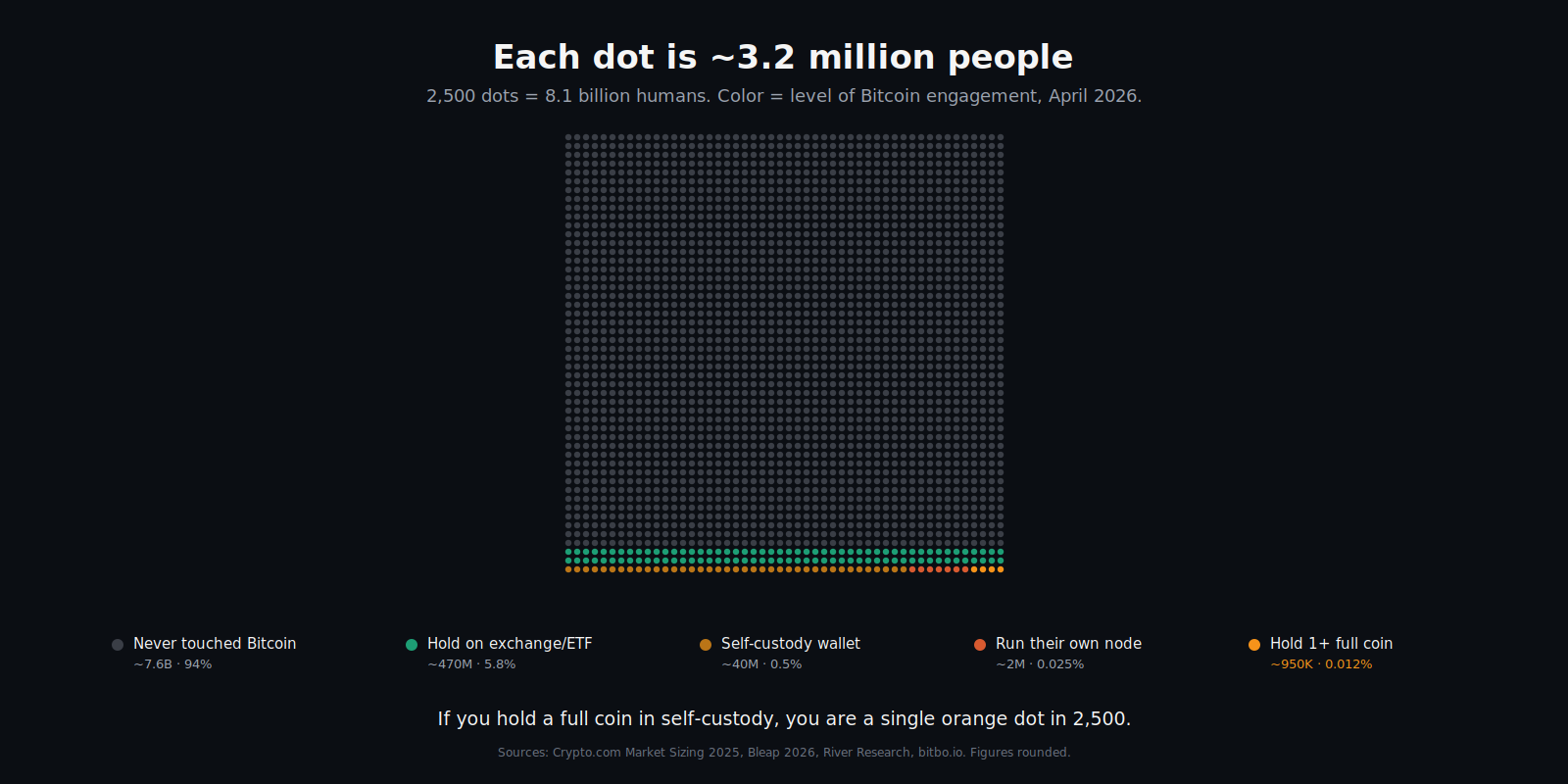
8.1 billion people on earth.
- 94% have never touched Bitcoin
- 5.8% hold on an exchange or ETF
- 0.5% self-custody
- 0.025% run a node
- 0.012% hold a full coin in their own wallet
If you are in that last group, you are four orange dots in 2,500. The gap is widening. Stack.
Where You Actually Stand in Bitcoin: The 0.012% Problem
Most people think they are early to Bitcoin. The numbers say otherwise for most, and say something much stronger for a tiny fraction.
Plot all 8.1 billion humans on a grid of 2,500 dots. Each dot represents roughly 3.2 million people. Color the dots by how deep each person has gone into Bitcoin. The result is brutal.
The picture is not a story about adoption growth. It is a story about sovereignty gradient. The gray mass is the entire human population that has never held a private key. The last row is the one that matters.
The Five Tiers
Bitcoin engagement is not binary. Owning a piece of BTC on Coinbase is not the same as running a Bitcoin Core node on a home server. The grid above separates people into five tiers, each a strict subset of the last.
Tier 1: Never touched Bitcoin (~94%)
About 7.6 billion people on earth have never owned any Bitcoin. Not on an exchange. Not in a wallet. Not in an ETF. They may have heard of it. They have not bought it.
This cohort includes most of the global population. It is the baseline.
Tier 2: Hold on an exchange or ETF (~5.8%)
Roughly 470 million people hold Bitcoin through some custodial product. A Coinbase balance. A Cash App position. A spot ETF share through Schwab or Fidelity. Total global crypto ownership sits around 741 million, of whom 365 million hold BTC specifically.
These people own Bitcoin exposure. They do not own Bitcoin. A company holds the keys. If the company fails, freezes, or is compelled by a government, the position is at risk.
This is not a criticism. It is a description of where the keys live.
Tier 3: Self-custody (~0.5%)
Roughly 40 million people hold Bitcoin in a non-custodial wallet. A hardware device. A mobile wallet with a seed phrase the user actually wrote down. A multisig setup.
This is the first tier where you truly own the asset. You also own all the risk. Lose the seed, lose the coins. Get phished, lose the coins. No support line.
Tier 4: Run their own node (~0.025%)
Roughly 2 million people run their own Bitcoin node. This includes reachable nodes on the public network, plus the much larger pool of unreachable nodes running behind home firewalls.
Running a node means you verify every block yourself. You do not trust a third-party RPC endpoint to tell you the chain state. You enforce the rules of Bitcoin on your own machine. This is the level where you are not just a holder. You are part of the network.
Tier 5: Hold at least one full coin (~0.012%)
Roughly 950,000 wallet addresses hold one or more full Bitcoin. Many of those wallets belong to exchanges and institutions. The number of individuals who personally hold a full coin in self-custody is smaller. Well under one million people. Likely closer to 500,000.
Four dots out of 2,500.
Why the Grid Matters
The "each dot is X million people" format strips out the things that distort Bitcoin conversations. Price. Hype cycles. Twitter sentiment. News coverage. None of that appears on the grid. What appears is a physical count of who actually holds what.
Three things jump out.
First, the gap between tier 2 and tier 3 is an order of magnitude. Going from custodial to self-custody removes roughly 92% of current Bitcoin holders. Most people who "own Bitcoin" do not hold the keys. The assumption that ETF demand is equivalent to coin demand breaks down here. ETF holders are buying a financial product. Self-custody holders are buying the asset itself.
Second, the gap between tier 3 and tier 4 is another order of magnitude. Most self-custody users never run a node. They trust a public block explorer or their wallet provider to tell them their balance. This is a subtle trust assumption, but it is real.
Third, the gap between any tier and the full-coin tier is fixed by math. Only 21 million coins will ever exist. Roughly 3 to 4 million are lost. Institutions hold 1.5 million plus. Satoshi holds around 1.1 million. The remaining supply available for individual full-coin ownership is a rounding error against 8 billion people.
What the Grid Does Not Show
A few caveats before anyone treats this as gospel.
Wallet counts are not person counts. One person can control many wallets. One wallet can be a custodial address for many people. Chain-level counts are a lower bound on some tiers and an upper bound on others.
Self-custody estimates vary widely. Some analysts count any non-custodial wallet address as a self-custody user. Others require signs of actual human control. The 40 million number is mid-range.
Node counts undercount. Bitnodes measures reachable nodes, which sits around 20,000. Total nodes including unreachable ones is estimated at 50,000 to 100,000. The 2 million estimate for "node runners" treats any historical node operator as counted. Live node operators are fewer.
The tiers are not perfectly nested in reality. A small number of people hold a full coin on an exchange, not in self-custody. The grid treats the tiers as a ladder because that is the aspirational frame. For a strict on-chain reality check, expect some fuzz at the boundaries.
What This Means If You Are Reading This
Most people who find their way to a Bitcoin-focused blog are already past tier 1. The question is which tier they are in, and whether they want to move up.
Moving from tier 2 to tier 3 requires a hardware wallet and a weekend of learning. Trezor, Coldcard, Blockstream Jade, or Ledger. Buy it from the manufacturer directly. Write down the seed phrase on paper or metal. Transfer a small amount first. Verify. Then move the rest.
Moving from tier 3 to tier 4 requires running software. Bitcoin Core on a home machine. Or a pre-built box like Umbrel, Start9, or Raspiblitz. The hardware cost is under $300. The time cost is a weekend for setup, plus the initial block download, which takes a few days.
Moving to tier 5 requires capital. At current prices, a full coin costs roughly $100,000 plus. Stacking sats consistently is the realistic path. Dollar-cost averaging over years. Most people who hold a full coin today started buying years ago at far lower prices.
The American Picture
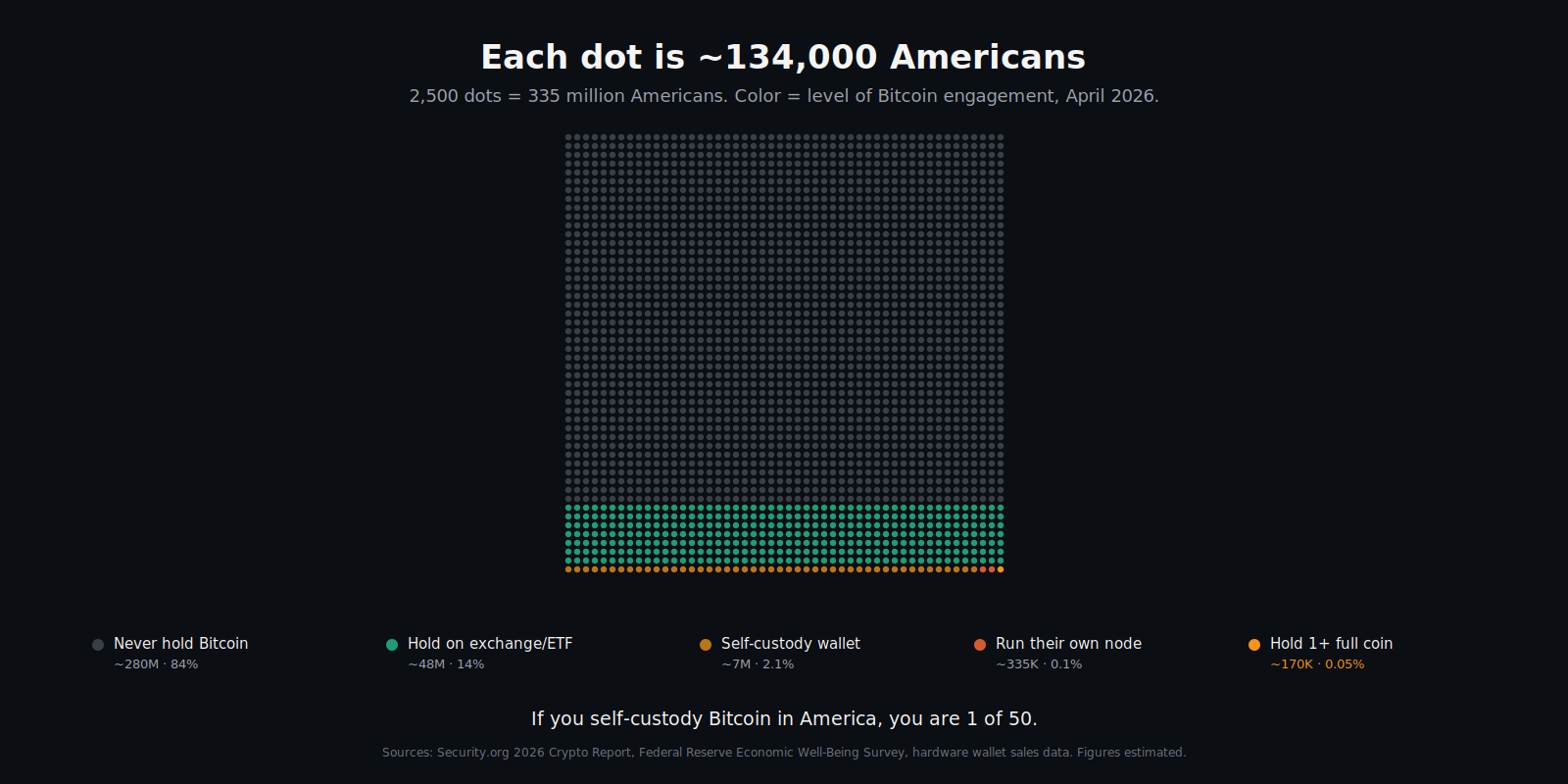
Americans own more Bitcoin than any other country, but most do not actually hold it. Roughly 55 million Americans hold some Bitcoin, which puts US ownership at about 16% of the adult population. Of those, only about 7 million hold their own keys. That is roughly 2.1% of all Americans, or 1 in 50. The split tells you everything about how Bitcoin entered the United States. Coinbase, Robinhood, Cash App, and spot ETFs made buying easy. Self-custody stayed hard. The result is a country that dominates Bitcoin ownership on paper and sits in the middle of the pack on actual sovereignty. A Coinbase balance is not Bitcoin. It is a claim on Bitcoin held by a company that can be hacked, frozen, or compelled. If you self-custody in America, you are not just early. You are in the sliver of Americans who actually finished the purchase.
The 0.012% Bet
In our first image the four dots out of 2,500 is a statement about where supply sits. It is also a statement about what happens if Bitcoin continues on its current trajectory.
If Bitcoin adoption doubles from here, the gray mass shrinks slightly. The teal band grows. The amber, coral, and orange sections barely move, because the supply constraint is hard. There cannot be more than 21 million full-coin wallets, ever. In practice there will never be more than roughly 1 million full-coin holders, and many of those seats are already taken by institutions that will not sell.
The people holding a full coin in self-custody today are sitting on a position that gets mathematically harder to replicate every year. Not because Bitcoin is magic. Because the denominator keeps growing and the numerator cannot.
That is the full-coin bet. Not a price prediction. A supply statement.
Final Thought
Stare at the grid for a minute. Find your own dot. Then decide whether you want to stay there.
The gap between tiers is not a technical barrier. It is a decision barrier. Every tier up requires more self-reliance, more time, and more willingness to be responsible for your own money. Most people will not make that trade. That is why the grid looks the way it does.
If you decide to move up a tier, do it slowly. Small amounts first. Verify every step. The network is not going anywhere.
Sources: Crypto.com Market Sizing Report 2025, Bleap Global Bitcoin Ownership 2026, River Research Bitcoin Distribution Study 2025, bitbo.io Bitcoin User Statistics, MEXC Bitcoin Ownership Breakdown 2026. Figures rounded for readability. Wallet counts, ETF holder counts, and population data as of Q1 2026.