Bitcoin’s “Paper” Game: Why the Price Keeps Getting Pushed Down… and Why That’s Secretly Bullish

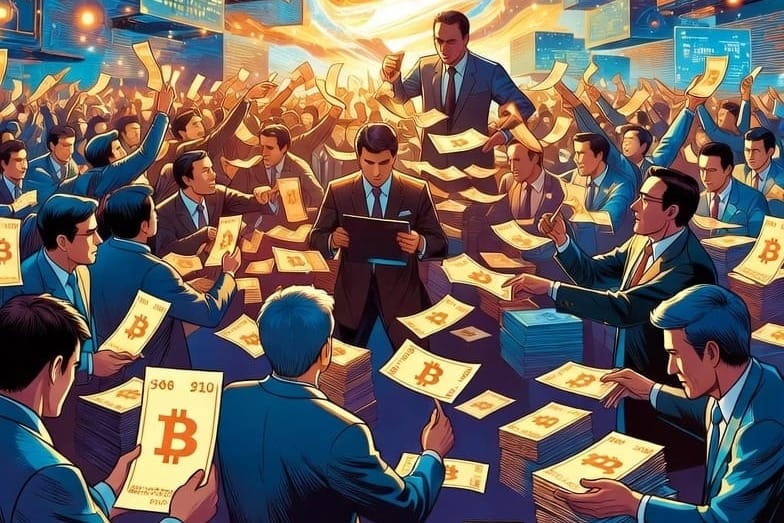
What Is “Paper Bitcoin”?
“Paper Bitcoin” is not real Bitcoin. It’s a bet on Bitcoin’s price without actually owning the real coin. Think of it like this:
- Real (spot) Bitcoin = the actual antique coin you take home and lock in your safe.
- Paper Bitcoin = casino chips that say “good for 1 Bitcoin” but stay inside the casino.
People trade trillions of dollars of these casino chips every single day, way more than the real coins that actually change hands. Examples of paper Bitcoin:
- Futures contracts on the CME or Binance
- Perpetual swaps (the most popular kind)
- Bitcoin ETFs that hold contracts instead of coins (some do, some don’t)
- Leveraged tokens like 2x or 3x Bitcoin
- Options and other derivatives
Right now (November 2025), for every $1 of real Bitcoin traded, about $4–$10 of paper Bitcoin changes hands. Why Does Paper Bitcoin Push the Price Down? When the price starts rising, big traders and hedge funds do a trick called “shorting the futures”:
- They borrow paper Bitcoin and sell it at the current high price.
- This floods the market with extra “supply” that doesn’t really exist.
- The price gets dragged lower, even though no one is selling their real coins.
The market is printing fake copies of the finite coin, one that has a hard supply cap of 21 million. and selling them to newcomers who don’t know the difference. The price of the real coin gets temporarily suppressed.
"We've created 8 Million Paper Bitcoin in the last 12 months"
— Fred Krueger (@dotkrueger) November 25, 2025
-- Dark
"We've created 8 Million Paper Bitcoin in the last 12 months"
The Good News: Paper Shorts Are Like a Loaded Spring. Every time someone opens a big short position, they promise:
“If the price goes up, I will buy back real Bitcoin to close my bet.” The lower the price goes, the more shorts pile in — because it looks “safe” to bet against Bitcoin when it’s dropping. That creates a mountain of future buying pressure. Picture a rubber band:
- Bears keep pulling the band down by adding more shorts.
- Real Bitcoin keeps quietly leaving exchanges and going into cold storage (people refusing to sell).
- One day the rubber band snaps back.
When that happens, all those shorts have to buy back real Bitcoin at the same time → massive short squeeze → price rockets upward extremely fast. We’ve seen mini versions of this many times:
- March 2020 → October 2020 squeeze (price 10x’d)
- October 2023 → March 2024 squeeze (price 4x’d)
- April 2025 → July 2025 squeeze (price went from $60k → $108k in weeks)
Each time, the heavier the paper shorts were, the bigger the explosion when they broke.
Where Are We Right Now? (November 2025)
- Bitcoin hit $108,000 two weeks ago and has dropped to around $87,000–$90,000.
- Paper short positions are near all-time highs.
- Funding rates (the “interest” longs pay shorts) are deeply negative, meaning shorts are getting paid to keep betting against Bitcoin.
- Real Bitcoin on exchanges is at the lowest level in 6+ years, people are not selling their coins.
Translation: The rubber band is stretched very tight again. So Is Paper Bitcoin Good or Bad Long-Term? Short-term: Annoying. It makes the price feel “fake” and stuck.
Long-term: Extremely good. Why?
- It lets the market absorb huge selling pressure without crashing the price forever.
- It traps greedy bears who eventually hand their money to long-term holders.
- Every short squeeze sends the price to a new all-time high, which brings in new buyers and starts the next cycle.
Paper Bitcoin is like training wheels for a $10–$20 trillion asset. The market is growing up, getting more professional tools, and those tools create bigger booms when the real scarcity finally wins.
Simple Takeaway
Don’t get upset when Bitcoin “won’t go up” even though ETFs are buying and countries are adding it to their treasuries. That’s the paper game doing its job: keeping the price lower for longer so more real coins can be quietly accumulated. When the shorts finally break (and they always do), the move up will be faster and higher than anyone expects, because there simply aren’t enough real coins to satisfy all the people who promised to buy them back. So the lower it goes on paper, the bigger the eventual rocket tends to be.Just keep stacking real sats while the Wall Street casino is busy printing chips.
One day the casino runs out of real coins to pay its debts… and that’s when the real fun begins.
